You can download instruction manuals and technical data sheets for our products.
The SDS (Safety Data Sheet) for our products is not available on this website.
We kindly ask that you contact us using the Request for Information format the bottom of this page.
If you require product information (SDS, TDS, etc.) for product numbers not listed on this page, please contact us using theRequest for Information form.
A sales representative will confirm your request and contact you.
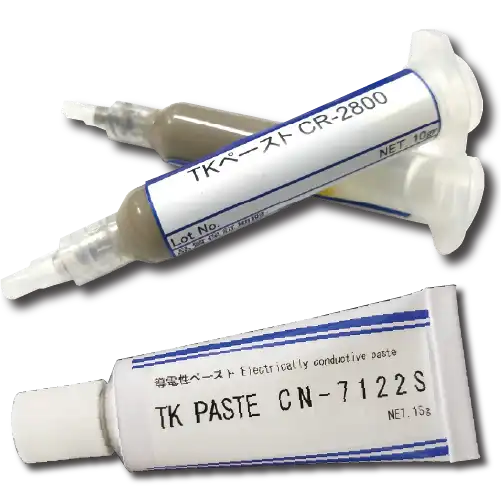
How do I open the syringe? Can I use it without a dispenser? How should I store it? We have compiled a list of frequently asked questions about the TK PASTE series of conductive adhesives developed by KAKEN TECH, ranging from questions about use and storage to how to obtain characteristic data.
Conductive adhesives and silver pastes have been attracting attention recently, but if used incorrectly, they will not perform adequately. Using thermosetting and drying types as examples, we will explain how to use conductive adhesives, including the steps of thawing, cleaning, application, and curing, as well as points to keep in mind.
KAKEN TECH has developed and offers a unique cleaning process using MICROCLEAN, a glycol-based cleaning agent, and MARKLESS R, a water-containing alcohol rinse agent. Introducing KAKEN TECH's unique cleaning agents and rinse agents that overcome the disadvantages of hydrocarbon-based cleaning agents and semi-aqueous cleaning systems.
Flux cleaning is essential for ensuring the reliability of high-density mounting substrates. Amidst stricter regulations on chemical substances, such as the discontinuation of alternative CFCs due to environmental regulations and VOC regulations based on Chinese GB standards, KAKEN TECH has developed the MICROCLEAN ECO and MARKLESS ECO series of high-performance, low-VOC cleaning agents that offer both higher precision cleaning and environmental compatibility.
Paste cleaning agent for SMT stencils and screen masks
Many materials, such as solder paste, thick film paste, conductive adhesives, resist ink, and temporary bonding agents (red bond), are printed using SMT stencils and screen masks. Cleaning the openings of these printing masks is essential for reducing printing defects.
The solder paste printing process is one of the most important processes in the PCB assembly process, and the cleanliness of the SMT stencil used is the key to improving the quality of the process and the product. On this page, we examine the optimal SMT stencil cleaning method based on the results of cleaning the SMT stencil with IPA, cleaning agents, and ultrasonic cleaners.
In the reflow process of electronics packaging, the most common method of supplying solder is to print solder paste using a metal mask. This section introduces the explanation of metal masks, the printing process, possible problems and cleaning.
HAJIKI (cissing) is a phenomenon in which a flowable paint comes into contact with a factor substance having a lower surface tension than that of the paint, and the factor substance spreads by being pulled by the paint, and the film thickness of the part becomes thinner.
Defects due to particles tend to be more serious due to paint-induced particles, dust, fiber scraps, insects, other minute materials and also due to electrostatic adsorption due to static electricity. Therefore, it is necessary to grasp and observe the conditions of the surrounding environment in order to solve these problems.
Sagety data sheet
Please request the Safety Data Sheet (SDS) by filling out the “Request for Product Information” form below and providing the necessary product numbers.
Request for product documents
If you require product documents (SDS, TDS or instruction manuals) for KAKEN TECH products, please contact us using the form below.
Our sales representative will contact you after confirming your request.
KAKEN TECH, MICROCLEANER, MICROCLEAN&MARKLESS and MARKLESS are trademarks of KAKEN TECH CO., LTD. in PRC.
KAKEN TECH is a trademark of KAKEN TECH CO., LTD. in the U.S..










 Inquiry form