Flux cleaning agent MICROCLEAN MARKLESS®

Swells and tears away hard-to-clean lead-free and halogen-free flux.
High-performance flux cleaning agent, MICROCLEAN MARKLESS®

A unique two-component (cleaning agent + rinse agent) process that ensures the insulation reliability of high-density printed circuit boards and semiconductor packages. It combines exceptional penetration into the minute gaps beneath chips with rapid drying, and contributes to a dramatic reduction in operating costs through zero-waste, in-line distillation recycling.

Product Features

01

Two-phase complementary cleaning that completely removes both nonpolar and polar components

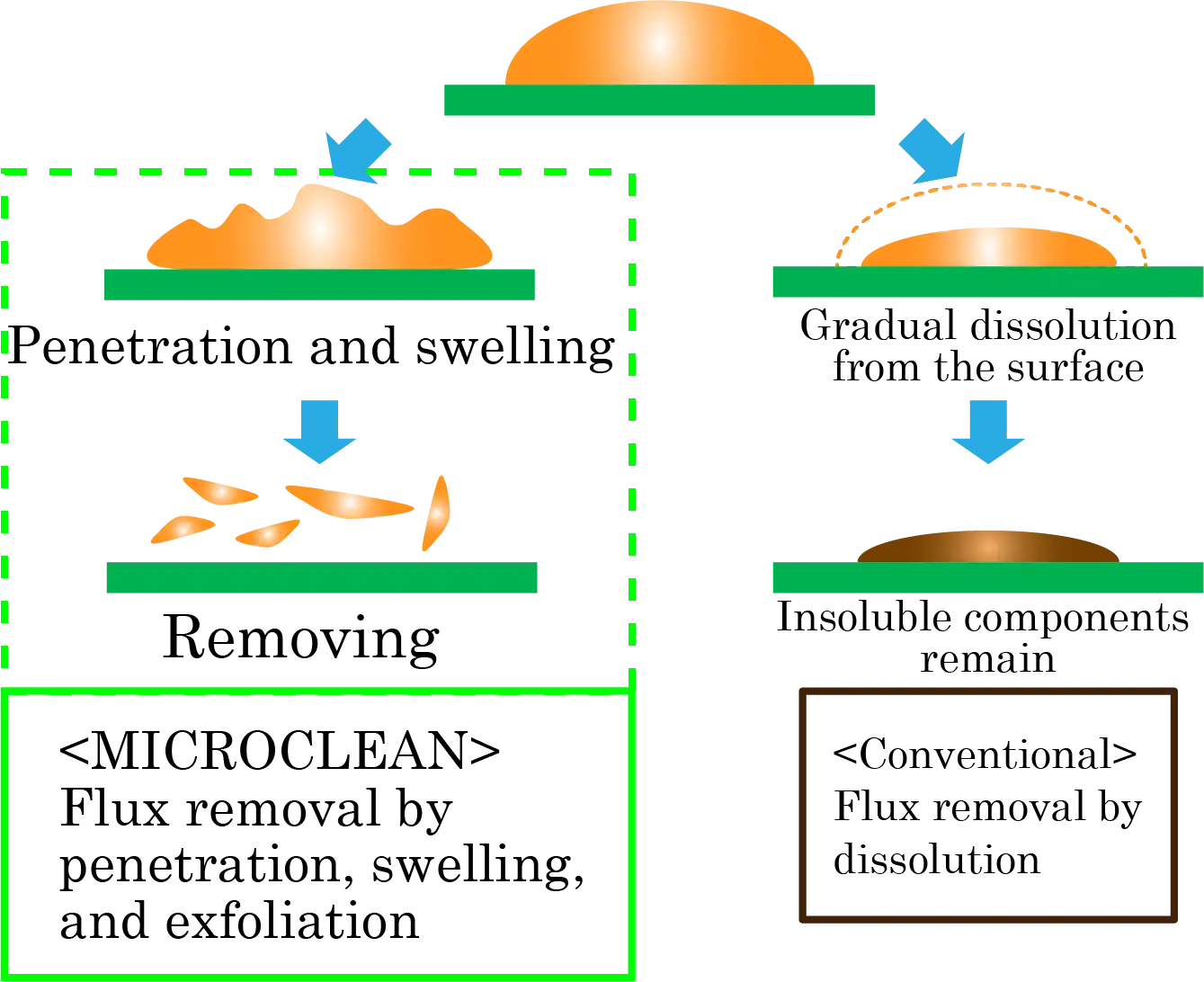
The cleaning agent MICROCLEAN softens, swells, and strips away rosin and thixotropic agents (nonpolar components) that make up flux residues, while the water-containing alcohol-based rinse agent MARKLESS powerfully displaces and removes the remaining metal salts and ionic compounds (polar components). It efficiently and completely cleans up lead-free and halogen-free residues, which are notoriously difficult to remove.

02

Ultra-fast, streak-free drying that completely eliminates the drawbacks of water rinsing h3>

The “MARKLESS” rinse agent boasts a drying speed approximately four times faster than water, completely drying even liquid residues hidden in the minute gaps beneath chips in a short amount of time. Due to its extremely low surface tension, it penetrates gaps effectively, preventing watermarks (drying marks and water stains)—which often occur during water drying—as well as corrosion and lead breakdown on mounted components and metal substrates.

03

Zero Wastewater and Low-Cost Operation via Closed-Loop Distiller and Recycling

The built-in distiller and recycling system within the dedicated cleaning equipment “MICROCLEANER®” allows contaminated rinse solution to be recycled within the unit. This eliminates the need for capital investments in large-scale factory wastewater treatment facilities or expensive water treatment membranes, enabling a low-cost, environmentally friendly process that minimizes the volume of waste (concentrated residue).

Common challanges

Are you facing capital investment challenges or quality issues in your batch-type automated flux cleaning process?

  • Inadequate drying and watermarks (drying marks) caused by conventional water-based cleaning agents
    Due to the poor drying properties inherent in water rinsing, moisture remains in the gaps of high-density printed circuit boards, causing inadequate drying; furthermore, conspicuous white watermarks (drying marks) remain after drying, significantly compromising product quality
  • The burden of maintaining water-based rinse tanks and the growth of algae and foreign matter due to water contamination
    It is difficult to control the quality of recycled rinse water (such as purified water), leading to sudden outbreaks of algae growth and contamination by microscopic foreign matter as the liquid deteriorates, forcing companies to deal with the hassle of frequent liquid replacement and maintenance
  • Enormous Initial Investment Costs for Explosion-Proof Equipment Required When Using Hydrocarbon-Based Cleaning Agents
    Although we considered introducing flammable hydrocarbon-based (alcohol-based) cleaning agents, but explosion-proof equipment and static electricity control devices are mandatory to ensure safety, and companies are struggling with the substantial initial costs, including peripheral infrastructure.
  • The introduction of wastewater treatment facilities specific to water-based systems and the strain of high operating costs
    Large volumes of cleaning wastewater containing chemicals cannot be discharged directly, and the maintenance of dedicated wastewater treatment facilities and oil-water separators, or the enormous operating costs associated with outsourcing wastewater collection are putting a strain on operations
  • Limitations in Meeting VOC Emission Reduction Targets and Improving the Working Environment in Cleaning Processes
    The company is struggling to reduce VOC (volatile organic compound) emissions resulting from the volatilization of hydrocarbon-based cleaning agents, as well as to address hot air and odors caused by heating water-based solutions to high temperatures (60°C or higher), and meeting health and safety standards

Development Highlights of the flux cleaning agent MICROCLEAN and the rinse agent MARKLESS®

At KAKEN TECH, we have developed and propose a proprietary cleaning process that combines the glycol-based cleaning agent “MICROCLEAN” with a water-based alcohol rinse agent using “MARKLESS®”. We introduce KAKEN TECH’s proprietary cleaning agents and rinse agents, which address the drawbacks of hydrocarbon-based cleaning agents and semi-aqueous cleaning systems.
■ Top Design Priorities in Electronic and Semiconductor Assembly Processes

  • The cleaning agent must not alter the circuit characteristics after cleaning.
    (Emphasis is placed not only on insulation resistance but also on dielectric properties)
  • Must exhibit high solubility and removal efficiency for flux residues (particularly ionic compounds) and other process contaminants remaining after soldering.
  • Must not adversely affect electronic components or other constituent materials.
    Alternatively, any adverse effects must be extremely minimal.
  • Must be highly safe for humans and the environment.
  • Must ensure a stable supply and have excellent recyclability.

Electronic circuit boards and components used in recent communication devices and modules require high-frequency design, making low transmission loss in board materials essential. While circuit board manufacturers are seeking materials with low dielectric constants, KAKEN TECH prioritizes designing cleaning agents that do not alter the properties of the circuit surface during the cleaning process.

As explained on the “What Is Flux Residue?” page, flux residue consists of components such as rosin, unreacted surfactants, thixotropic agents, metal salts (such as tin salts), among others; these components can be broadly classified into nonpolar (lipophilic) and polar (hydrophilic) components.
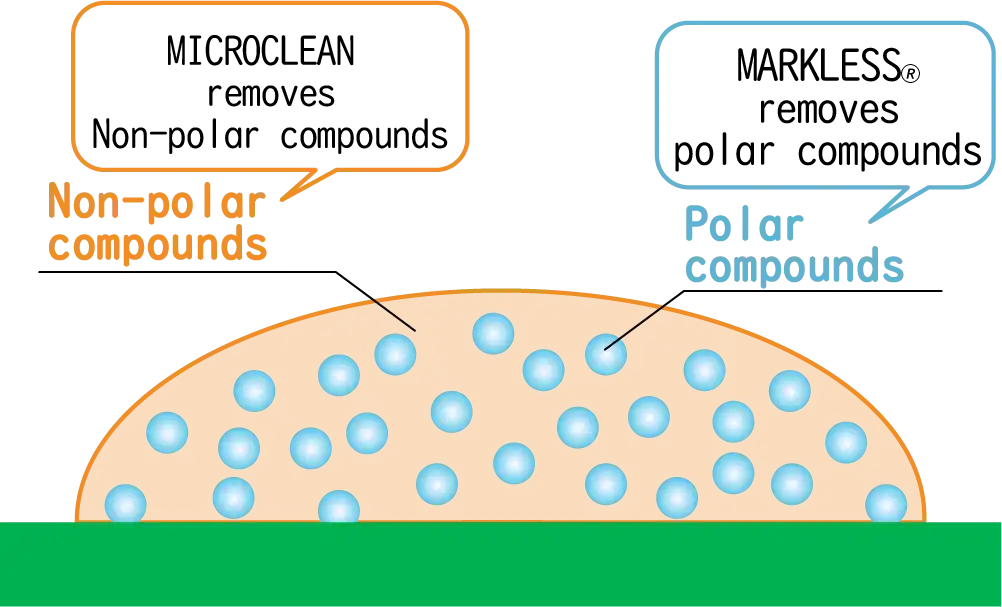

Flux Residue Model

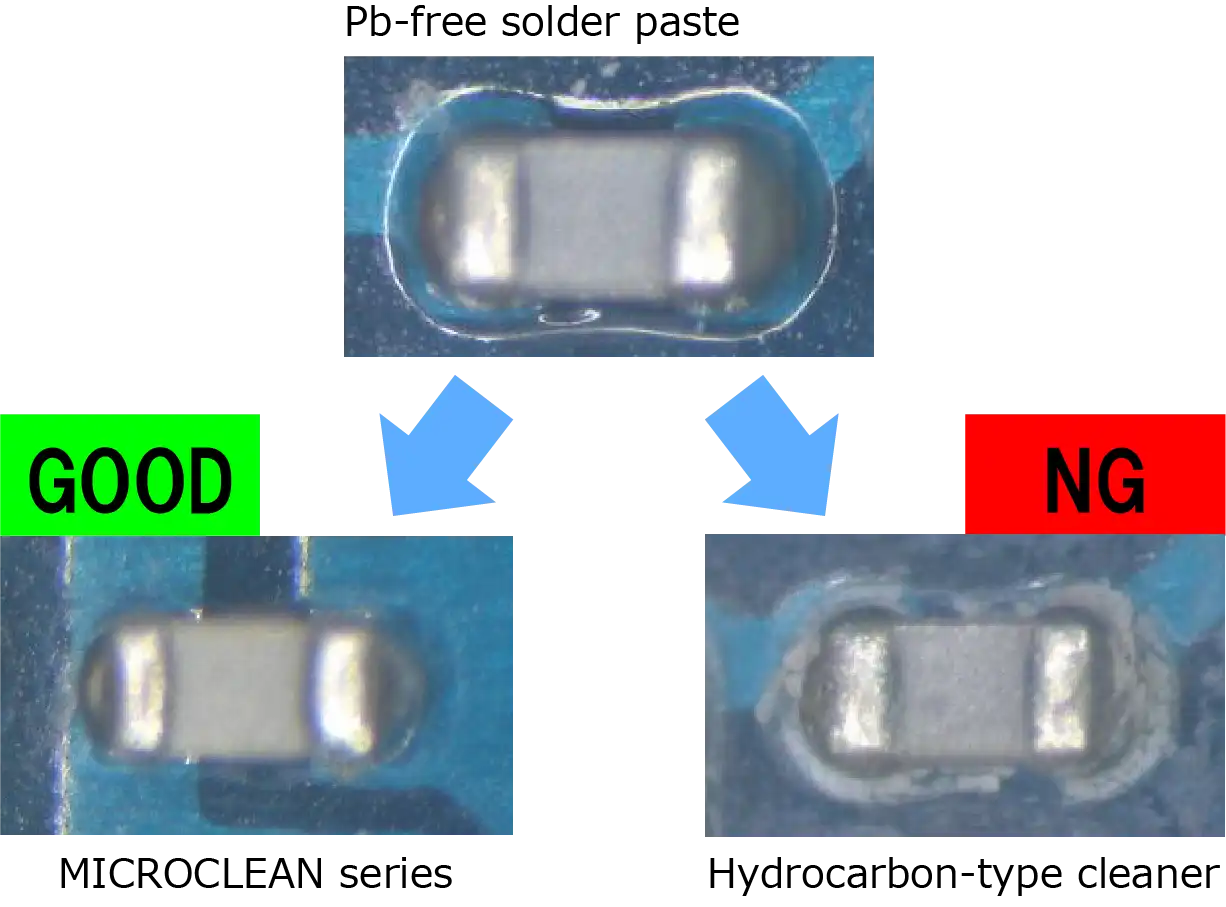
KAKEN TECH’s flux cleaning system uses the MICROCLEAN series of cleaning agents to remove nonpolar components, while the MARKLESS® rinse agent removes polar components, enabling efficient and complete removal of flux residue.

The Secret Behind the MICROCLEAN Series’ High Cleaning Power

Lead-free solder flux residues contain hard-to-dissolve components such as metal salts, making it difficult to completely remove these residues with conventional cleaning agents that focused solely on dissolving power. KAKEN TECH’s MICROCLEAN series of flux cleaning agents is characterized by its high cleaning performance because it not only dissolves flux but also incorporates a mechanism that penetrates even hard-to-dissolve flux residue films, causing them to swell and peel away.

MARKLESS®, an aqueous alcohol-based rinse agent that overcomes the drawbacks of water rinsing

KAKEN TECH has developed MARKLESS®ST-05, a water-in-alcohol-based cleaning agent for flux cleaning, rather than a water-based rinse.
We will compare and verify the decisive advantages of the water-in-alcohol-based cleaning agent “MARKLESS®,“ based on practical technical facts.

Comparison Criteria Aqueous Alcohol-Based ”MARKLESS®" Conventional “Water Rinse (Water Wash)”
Penetration and Displacement Performance in Microscopic Gaps
Surfactant-Free for Complete Protection of Circuit Characteristics
Due to its extremely low surface tension, it instantly penetrates even the narrowest gaps beneath high-density mounted chips. It reliably displaces and removes cleaning agents. Since it contains absolutely no non-volatile components (such as surfactants), it does not compromise electronic circuit characteristics—such as dielectric constant and insulation resistance—which are critical for high-frequency circuit boards.
Deterioration of Circuit Characteristics Due to Surfactant Residue
Because water has high surface tension, it cannot penetrate fine gaps, resulting in residual liquid (incomplete displacement of the cleaning agent). For this reason, other manufacturers add surfactants to make the solution more hydrophilic; however, these surfactants can remain on the board surface, posing a risk of significant deterioration in circuit characteristics such as dielectric properties.
Drying Performance &
Water Marks
Ultra-Fast Drying, Approx. 4x Faster Than Water, No Drying Marks
It possesses excellent volatility nearly equivalent to that of alcohol (IPA) and boasts a drying speed in gaps approximately four times that of water. It achieves significant reductions in drying time and energy consumption while fundamentally preventing the occurrence of white spots and watermarks (drying marks).
Long drying cycles, Frequent occurrence of drying marks]
Water has a high latent heat of vaporization and is extremely difficult to dry, leading to prolonged drying times and increased electricity costs for drying ovens. Additionally, fine impurities in the water tend to become concentrated during the drying process, frequently causing watermarks that result in defects on the external view.
Component Resistance/Risk of Solution Spoilage Suppression of Metal Corrosion and Spoilage via Alcohol Properties]
Our proprietary water-alcohol composition (a hybrid of water and alcohol) overcomes the weaknesses of water. The antibacterial and anti-corrosion properties of alcohol reliably prevent metal corrosion and lead breakdown in delicate solder components, while also completely preventing liquid spoilage.
Algae and Foreign Particles Caused by Premature Liquid Spoilage
Water poses a high risk of directly corroding metal substrates, requiring frequent water changes and drainage. Furthermore, it is difficult to prevent water spoilage (algal and fungal growth) inside pure water tanks and piping; when these organisms flake off, they become the primary cause of “contaminant-related defects.”
Discharge Management &
Operating Costs
Zero-Waste Operation via In-System Distillation Recycling
The Distiller, which comes standard in the company’s automatic cleaning equipment “MICROCLEANER®,” enables 100% complete recycling within the system. Since absolutely no wastewater is generated and the only waste is the concentrated residue remaining after distillation, waste liquid costs can be minimized.
Significant Water Treatment Energy Consumption and Wastewater Treatment Burden
Reusing (recycling) used pure water requires large-scale filtration membranes (separation membranes) and significant regenerative energy, leading to soaring maintenance costs, including equipment replacement. Furthermore, if there is no wastewater treatment infrastructure within the factory, enormous costs are incurred for wastewater disposal.

General Properties and Regulatory Requirements

Product Name Flux Cleaning Agent Rinse Agent
MICROCLEAN
WS-3220U
MICROCLEAN
WS-2107U
MICROCLEAN
RW-4180U
MARKLESS®
ST-05U
Merit Pb-free compatible
(utility type)
Pb-free compatible
(For difficult to clean)
Non DG type -
Main ingredient Alcoholic Alcoholic Glycol-based Alcoholic
Specific gravity
(20℃)
1.00 1.05 0.98 0.89
Viscosity
mPa.s(20℃)
9.3 9.7 11.0 2.3
Surface tension
mN/m(20℃)
35 44 36 26
Boiling point
(℃)
200以上 200以上 100以上 81
Flash point
(℃)
105 100 - 24
Ozone
destruction coefficient
0 0 0 0
Catalog
Download

Cleaning Equipment

Thumbnail for the flux cleaning machine product page Product Information
Flux Cleaning Machine: MICROCLEANER®
In recent years, as electronic devices have become smaller and component mounting has become more densely packed, electronic circuits and components are required to be of increasingly higher quality and reliability, leading to a growing demand for flux cleaning. The MICROCLEANER® is the definitive flux cleaner! It contributes to improving the quality of printed circuit boards and electronic components.

Frequently Asked Questions

What kind of cleaning equipment is used with this product? Please tell me about the equipment specifications.
The dedicated cleaning machine is the MICROCLEANER® flux cleaning machine. For more details, please visit the product page.

Go to the Flux Cleaning Machine page

I’m not sure which cleaning agent is suitable. Can you recommend an appropriate cleaning agent based on my solder paste and flux?
Please provide us with the manufacturer and part numbers of your solder paste and flux. We maintain in-house cleaning data for each type of solder paste and flux, so we will investigate and recommend the appropriate cleaning agent.
In addition, our research laboratory offers cleaning tests using actual workpieces.
Information regarding the cleaning agent I am using or the one recommended to me is not listed on the website.
Only a selection of flux cleaning agents is listed on our website. If you need product documentation for part numbers not listed, please contact us via the Inquiry Form or Document Request Form.

Related Articles

Thumbnail for the technical documentation page on flux cleaning Magazine Article
Technical Documentation ~ Flux Cleaning ~
Excerpt from Micro Mounting and Bonding Technology (2012).
This article explains the evolution of flux cleaning agents, the purpose and fundamental significance of flux cleaning, and current technologies and future challenges, focusing on glycol ether-based cleaning agents—the most widely used flux cleaning agents in today’s assembly operations.
Thumbnail for the technical documentation page on cleaning machines in the assembly process Magazine Articles
Cleaning Machines for the Assembly Process
Excerpt from *Micro Assembly and Bonding Technology (2012). This article explains the fundamentals of designing flux cleaning processes, as well as representative cleaning systems with a proven track record in the mounting process and examples of cleanliness control.
 
Thumbnail for the flux explanation page PCB Assembly Column
The Key Player in Soldering! What Is Flux?
Flux is a soldering aid composed of ingredients such as rosin (pine resin), activators, and solvents. This page explains the role and types of flux.
 
Thumbnail for the page explaining flux cleaning Troubleshooting Guide
What Is Flux Cleaning?
“Flux cleaning” is the process of removing flux residue that is generated during soldering when mounting electronic components. This page explains why flux needs to be cleaned, what cleaning methods are available, and what is required for efficient cleaning.
 

Consultations on preliminary proof-of-concept cleaning tests or samples

“Our current water-based cleaning process fails to resolve watermarks or poor drying on high-density PCBs.” “We’d like to consider hydrocarbon-based solutions, but are concerned about the enormous investment costs for explosion-proof facilities.” “We want to fully protect circuit characteristics without using surfactants”—do you face any challenges like these in your automated flux cleaning process?
We can conduct a series of test cleanings at our lab tailored to the specific types of solder (lead-free, halogen-free) your company currently uses, as well as your PCB sizes and production cycle times. Please feel free to contact us for a consultation to help you build the optimal system.

Inquiry and question

Requests for SDS

Please be as specific as possible in your inquiry.
Depending on the contents of your inquiry, it may take some time for us to reply to you.
For SDS, please contact us from [Requests for SDS] in the upper right corner.
※Sales through the inquiry form are strictly prohibited.

KAKEN TECH, MICROCLEANER, MICROCLEAN&MARKLESS and MARKLESS are trademarks of KAKEN TECH CO., LTD. in PRC.
KAKEN TECH is a trademark of KAKEN TECH CO., LTD. in the U.S..

Contact Us

PAGETOP