Conductive Connections Without Heating.
Room-Temperature-Drying Conductive Adhesives
"TK Paste CN Series"
TK Paste CN-7120 and CN-7122S are room-temperature-drying conductive adhesives that require no heating.
They were developed for heat-sensitive electronic components, film devices, and wearable devices. After drying at room temperature, they maintain a flexible coating and are suitable for grounding and shielding connection applications.
Product Features
01
Conductive Connections Without Heating, Simply by Drying at Room Temperature
Electrical conductivity can be achieved simply by drying at room temperature, without using a curing oven or heating equipment. It is suitable for conductive connections to heat-sensitive resin components and film materials, and can also be used to add conductivity in post-assembly processes.
02
Flexible Coating Resistant to Bending
Because it forms a flexible coating even after drying, it can be used on components subject to bending and deformation. It provides stable conductivity in flexible applications such as wearable devices and film devices.
03
Ideal for Grounding and Shielding Connections
The CN Series is a conductive adhesive developed for grounding and ground connection applications. It can easily add conductivity for post-assembly conductive connections and for grounding shielding cases.
Common Challenges with Conductive Connections in Electronic Components
- Need to Add Conductivity to Materials That Cannot Be Heated
Heat-sensitive resin or film materials make conductive connection methods difficult to select.
- Need to Add a Ground Connection After Assembly
You want an easy way to add conductive connections or grounding to a finished product.
- Large Workpieces Do Not Fit in an Oven
Heating equipment cannot be used, so you need a material that can provide conductive connections at room temperature.
- Wiring Breaks in Wearable Devices
You need a flexible conductive material that can withstand bending and deformation.
- Grounding Connections to ITO Glass or Films
You want to improve the grounding method used for LCD panels or touch panels.
What Is a Room-Temperature-Drying Conductive Adhesive?
A room-temperature-drying conductive adhesive is a material that enables conductive connections without heating. In addition to electronic component assembly, it is used for grounding connections, shielding connections, conductive treatment of film devices, and other processes where heat cannot be applied.
Difference Between Room-Temperature-Drying and Thermosetting Conductive Adhesives
| Item |
CN-7120 |
Typical Thermosetting Type |
| Heating Process |
Not Required |
Required |
| Heat-Sensitive Materials |
◎ |
△ |
| Post-Assembly Conductive Treatment |
◎ |
△ |
| Flexibility |
◎ |
△ |
| Mass-Production Assembly |
○ |
◎ |
Room-Temperature-Drying Conductive Adhesives CN-7120 / CN-7122S
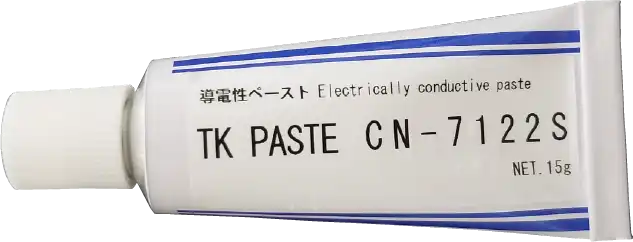 |
TK Paste CN-7120 is an easy-to-use, one-component, room-temperature-drying paste that requires no heating for curing.
It is ideal for conductive bonding of heat-sensitive electronic components. The tube packaging also makes it easy to handle.
NEW!! The slow-drying CN-7122S is also available! Its slower drying speed improves workability when positioning parts after applying the paste. |
| The TK Paste CN Series is free of toluene, acetone, xylene, and thinner! It contains no highly toxic components. |
Properties
Fast-Drying Type CN-7120
Slow-Drying Type CN-7122S
Main Applications
- Ground Connections for ITO Glass
- Grounding Connections for Touch Panels
- Wearable Devices
- Film Devices
- Shielding Case Connections
- Electrostatic Discharge Countermeasures
- Post-Assembly Grounding of Electronic Equipment
- SEM Sample Fixing
Frequently Asked Questions
What is a room-temperature-drying conductive adhesive?
A room-temperature-drying conductive adhesive is a material that develops electrical conductivity simply by drying at room temperature without using heating equipment. It is used for electronic components and film devices where heat damage should be avoided, as well as for grounding connections.
Can it be used without heating equipment?
Yes. CN-7120 and CN-7122S are room-temperature-drying types that require no heating. Conductive connections can be made without a curing oven or other heating equipment, making them suitable for large workpieces and materials that cannot be heated.
What is the difference between CN-7120 and CN-7122S?
CN-7120 is a fast-drying type, while CN-7122S is a slow-drying type. Because CN-7122S dries more slowly, it is suitable when additional working time is needed for positioning or assembly.
Does TK Paste need to be stored frozen?
To maintain product quality, we recommend storing TK Paste frozen at -10℃ or below. Before use, allow the product to thaw naturally to room temperature. Please refer to the technical documentation and instruction manual for each product for details.
Can it be used with film devices?
Yes. Because the CN Series requires no heating and forms a flexible coating, it is suitable for conductive connections to film devices and flexible components.
Can it be used with wearable devices?
Yes. Because it forms a flexible coating even after drying, it is suitable for conductive connection applications in wearable and mobile devices that are frequently bent or deformed.
Can it be used for grounding ITO glass and touch panels?
Yes. The CN Series can be used for ground connections from ITO glass surfaces and for grounding touch panels and LCD panels.
Can it be used for grounding after assembly?
Yes. The CN Series can also be used to add conductivity to assembled equipment and shielding cases. It is used as a post-assembly grounding and ground connection material.
Can conductivity be maintained when bent?
The dried coating is highly flexible and designed to resist cracking caused by bending and deformation. This allows it to maintain conductivity on film substrates and flexible components.
Can it also be used to fix samples for SEM observation?
Yes. The CN Series is also used for fixing samples during SEM observation. It is useful when fixing samples with complex shapes or when electrical conductivity must be provided.
Can it be applied with a dispenser?
Yes. It can be applied using a dispenser. Please refer to the technical documentation for recommended needle diameters and application conditions.
Can bonded parts be removed after room-temperature drying?
In some cases, fixed samples or components can be removed by reheating after drying. It can also be used for evaluation and temporary fixing applications.
Is frozen storage required?
To maintain quality, we recommend storing the CN Series frozen at -10℃ or below. Bring the product back to room temperature before use.
Other TK Paste Products
Related Articles
 |
Product Information
- Frequently Asked Questions About Conductive Adhesives
- How do I open a syringe? Can I use the product without a dispenser? How should it be stored? This page provides answers to frequently asked questions about KAKEN TECH's TK Paste conductive adhesive series, covering everything from usage and storage to how to obtain product performance data.
|
 |
Product Information
- Low-Temperature Thermocompression-Bonding Conductive Sheet for Transparent Conductive Films
- Anisotropic conductive films (ACFs) and conductive adhesives are sometimes used instead of soldering to form conductive connections with heat-sensitive film devices. However, each has disadvantages that can prevent film devices from achieving their full performance. To address these challenges, KAKEN TECH developed TKS-030, a conductive paste that can be bonded at low temperatures.
|
 |
Product Information
- TK Paste CR-5200 Conductive Adhesive
- Advances in mobile and wearable devices have led to increased use of lightweight, thin components made from resins and films. CR-5200 was developed for conductive bonding of components and circuits with low heat resistance. Using specially shaped TK Silver Powder, it provides low electrical resistance and excellent reliability.
|
 |
Technical Solutions
- What Are Conductive Adhesives Made with TK Silver Powder?
- Discover KAKEN TECH's unique technology for low-silver, low-specific-gravity conductive adhesives using specially shaped silver powder. What makes TK Silver Powder unique? Why can it provide conductivity with less silver? What are the advantages of reducing silver content? This article answers these questions and more.
|
 |
Technical Solutions
- What Are Conductive Adhesives?
- Conductive adhesives have attracted increasing attention in recent years. This article explains how they conduct electricity, the different types of conductive adhesives, how they differ from solder and conventional adhesives, and why conductive adhesives are needed.
|
 |
Technical Solutions
- How to Use Conductive Adhesives / Silver Paste
- Conductive adhesives and silver pastes have attracted increasing attention in recent years, but incorrect handling can prevent them from delivering their full performance. Using thermosetting and drying types as examples, this guide explains how to use conductive adhesives and highlights important points for each step: thawing, cleaning, application, and curing.
|
 |
Technical Documents
- Layer Materials, Film-Formation Processes, and Device Design for Improving the Durability, Stability, and Power Generation Efficiency of Perovskite Solar Cells
- As perovskite solar cells approach practical implementation, research and development are also advancing on module structures and manufacturing methods that ensure mass productivity and reliability. This article introduces a low-temperature thermocompression-bonding conductive material that we are developing for use as external electrodes in film-type perovskite solar cells.
|
The information provided on this page is for reference purposes and is based on evaluation data and technical knowledge obtained by KAKEN TECH. Actual applicability and performance may vary depending on the conditions of use, adherend materials, design conditions, operating environment, and other factors. Before adopting the product, please conduct sufficient evaluation and verification under your actual operating conditions and make your own determination. KAKEN TECH does not guarantee performance or suitability for the applications or examples described on this page.



 Inquiry form
