High-Reliability Bonding Through Silver Sintering.
High-Thermal-Conductivity Die-Bonding Paste for Next-Generation Power Semiconductors
"TK Paste CM-4230"
CM-4230 is a lead-free, high-thermal-conductivity die-bonding paste based on silver sintering technology. It achieves high thermal conductivity of 170 W/m$00B7K, high electrical conductivity, and low-temperature sintering, making it suitable for high-reliability bonding of next-generation power devices such as SiC and GaN.
Product Features
01
High-Reliability Bonding Through Silver Sintering
CM-4230 is a silver-sintering conductive bonding material. It provides high-heat-resistance and high-reliability bonding that is difficult to achieve with resin-based adhesives, making it suitable for applications requiring long-term durability.
02
High Heat Dissipation with Thermal Conductivity of 170 W/m・K
CM-4230 achieves a high thermal conductivity of 170 W/m・K. It efficiently dissipates heat from power semiconductors and high-power electronic components that generate large amounts of heat, helping stabilize device performance.
03
Excellent Sinterability at Low Temperatures Without Pressure
Excellent sintering is possible at 200℃ in air and 250℃ in a nitrogen atmosphere. Because bonding can be performed without pressure equipment, CM-4230 can also help improve productivity and reduce equipment requirements.
Are You Facing Any of These Challenges in Power Device Mounting?
- High Heat Generation from Power Semiconductors
Insufficient heat dissipation is causing performance degradation and shorter service life.
- Need to Transition to Lead-Free Bonding
You are considering lead-free bonding materials to comply with environmental regulations.
- Insufficient Bonding Reliability in High-Temperature Environments
You have concerns about the long-term reliability of solder joints or resin adhesives.
- Need to Support Next-Generation Power Devices
You are looking for high-heat-resistance, high-thermal-conductivity bonding materials for SiC and GaN devices.
- Want to Sinter Without Pressure Equipment
You want to introduce silver-sintered bonding while minimizing equipment investment.
What Is Silver Sinter Bonding?
Silver sinter bonding is a technology in which fine silver particles are sintered by heating to form a bonding layer. Compared with conventional solder bonding, it provides higher heat resistance and thermal conductivity and has recently attracted attention as a bonding technology for next-generation power semiconductors such as SiC and GaN.
Comparison with Typical Lead-Free Solder
| Item |
CM-4230 |
Typical Lead-Free Solder |
| Bonding Method |
Silver Sintering |
Solder Bonding |
| Thermal Conductivity |
◎ |
○ |
| High-Temperature Reliability |
◎ |
△ |
| Lead-Free |
◎ |
◎ |
| Power Semiconductors |
◎ |
○ |
High-Thermal and electrical Conductivity Sintering Paste CM-4230
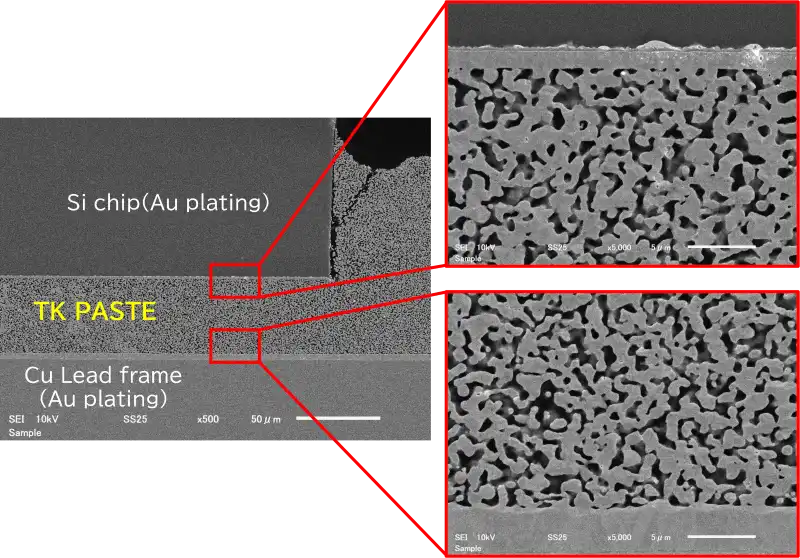 |
TK Paste CM-4230, a highly conductive and highly thermally conductive silver paste that sinters at low temperatures, is a high-heat-dissipation die-bonding paste. It supports pressureless sintering in an N2 atmosphere and can be sintered at 200℃ in air. The bonding layer can also be further densified through pressure-assisted heating. |
Properties
Main Applications
- SiC Power Modules
- GaN Power Devices
- IGBT Modules
- High-Power LED Mounting
- Automotive Power Electronics
- EV Inverter Modules
- DC-DC Converters
- Power Modules for Industrial Equipment
- High-Heat-Resistance Electronic Component Mounting
- High-Thermal-Conductivity Die-Bonding Applications
Frequently Asked Questions
What is silver sinter bonding?
Silver sinter bonding is a technology in which silver particles are sintered together by heating to form a bonding layer. Compared with solder bonding, it can provide higher heat resistance, thermal conductivity, and electrical conductivity and is increasingly being adopted for mounting power semiconductors and high-reliability electronic components.
What kind of product is CM-4230?
CM-4230 is a lead-free, high-thermal-conductivity die-bonding paste based on silver sintering technology. It combines high thermal conductivity of 170 W/m$00B7K with high electrical conductivity and can be used as a bonding material for next-generation power semiconductors such as SiC and GaN.
What is die-bonding paste?
Die-bonding paste is a material used to bond semiconductor chips to substrates or lead frames. It is used in semiconductor mounting processes that require electrical conductivity, heat dissipation, and bonding reliability.
What is the thermal conductivity of CM-4230?
The thermal conductivity of CM-4230 is 170 W/m$00B7K. It efficiently dissipates heat from power semiconductors and high-power electronic components that generate large amounts of heat, helping suppress increases in device temperature.
Is CM-4230 lead-free?
Yes. CM-4230 is a lead-free silver sintering paste that contains no lead. It can also be considered for electronic component mounting applications where compliance with environmental regulations and RoHS is required.
Can CM-4230 be used for mounting SiC power devices?
Yes. Because CM-4230 combines high heat dissipation with high electrical conductivity, it is suitable for SiC power modules and power device mounting applications used in high-temperature environments.
Can it also be used with GaN power devices?
Yes. CM-4230 can be considered for GaN power devices, high-frequency devices, and other applications requiring high heat dissipation and bonding reliability.
Does CM-4230 support pressureless sintering?
Yes. CM-4230 can be sintered without pressure at 200℃ in air or 250℃ in a nitrogen atmosphere. The bonding layer can also be further densified by applying pressure during heating.
How does silver sinter bonding differ from solder bonding?
Compared with typical solder bonding, silver sinter bonding can provide higher heat resistance, thermal conductivity, and electrical conductivity. For this reason, it is attracting attention as a bonding material for power modules and automotive electronics used in high-temperature environments.
How should CM-4230 be stored?
To maintain product quality, store CM-4230 frozen at -10℃ or below. Before use, allow it to return to room temperature and thaw completely.
Other TK Paste Products
Related Articles
 |
Product Information
- Frequently Asked Questions About Conductive Adhesives
- How do I open a syringe? Can I use the product without a dispenser? How should it be stored? This page provides answers to frequently asked questions about KAKEN TECH's TK Paste conductive adhesive series, covering everything from usage and storage to how to obtain product performance data.
|
 |
Product Information
- Low-Temperature Thermocompression-Bonding Conductive Sheet for Transparent Conductive Films
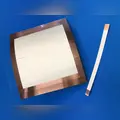
- Anisotropic conductive films (ACFs) and conductive adhesives are sometimes used instead of soldering to form conductive connections with heat-sensitive film devices. However, each has disadvantages that can prevent film devices from achieving their full performance. To address these challenges, KAKEN TECH developed TKS-030, a conductive paste that can be bonded at low temperatures.
|
 |
Product Information
- TK Paste CR-5200 Conductive Adhesive
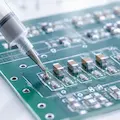
- Advances in mobile and wearable devices have led to increased use of lightweight, thin components made from resins and films. CR-5200 was developed for conductive bonding of components and circuits with low heat resistance. Using specially shaped TK Silver Powder, it provides low electrical resistance and excellent reliability.
|
 |
Technical Solutions
- What Are Conductive Adhesives Made with TK Silver Powder?
- Discover KAKEN TECH's unique technology for low-silver, low-specific-gravity conductive adhesives using specially shaped silver powder. What makes TK Silver Powder unique? Why can it provide conductivity with less silver? What are the advantages of reducing silver content? This article answers these questions and more.
|
 |
Technical Solutions
- What Are Conductive Adhesives?
- Conductive adhesives have attracted increasing attention in recent years. This article explains how they conduct electricity, the different types of conductive adhesives, how they differ from solder and conventional adhesives, and why conductive adhesives are needed.
|
 |
Technical Solutions
- How to Use Conductive Adhesives / Silver Paste
- Conductive adhesives and silver pastes have attracted increasing attention in recent years, but incorrect handling can prevent them from delivering their full performance. Using thermosetting and drying types as examples, this guide explains how to use conductive adhesives and highlights important points for each step: thawing, cleaning, application, and curing.
|
 |
Technical Documents
- Layer Materials, Film-Formation Processes, and Device Design for Improving the Durability, Stability, and Power Generation Efficiency of Perovskite Solar Cells
- As perovskite solar cells approach practical implementation, research and development are also advancing on module structures and manufacturing methods that ensure mass productivity and reliability. This article introduces a low-temperature thermocompression-bonding conductive material that we are developing for use as external electrodes in film-type perovskite solar cells.
|
The information provided on this page is for reference purposes and is based on evaluation data and technical knowledge obtained by KAKEN TECH. Actual applicability and performance may vary depending on the conditions of use, adherend materials, design conditions, operating environment, and other factors. Before adopting the product, please conduct sufficient evaluation and verification under your actual operating conditions and make your own determination. KAKEN TECH does not guarantee performance or suitability for the applications or examples described on this page.
KAKEN TECH, MICROCLEANER, MICROCLEAN&MARKLESS and MARKLESS are trademarks of KAKEN TECH CO., LTD. in PRC.
KAKEN TECH is a trademark of KAKEN TECH CO., LTD. in the U.S..


 Inquiry form
