Paint piping cleaner SL-709U

Published on :

Powerfully Removes Hardened Paint Deposits from Paint Lines, a Major Cause of Particle Defects!
Paint Line Cleaner "SL-709"

SL-709 is easy to handle and contains neither alkalis nor acids, eliminating the need for neutralization treatment.
It reliably removes sources of particle defects and helps improve production yield.

Features Solutions Cleaning Performance How to Use
Properties Related Articles

Product Features

01

High Dissolving Power

Powerfully dissolves and removes paint accumulated and hardened in joints, bends, pumps, and other areas.

02

No Neutralization Treatment Required

Because SL-709 contains neither alkalis nor acids, neutralization treatment is not required.

03

Designed with Regulatory Compliance and Workplace Safety in Mind

SL-709 is designed with consideration for the environment and worker safety. It is not subject to applicable Japanese organic solvent regulations and is not classified as a hazardous material under Japan's Fire Service Act, helping simplify handling and storage.

Are You Facing These Cleaning and Maintenance Challenges in Painting Lines or Paint Piping?

  • Particle defects caused by hardened paint deposits inside piping
    Dried and hardened paint residues around color changers, pipe joints, and liquid-level interfaces can detach and cause serious particle defects during color changes, reducing product yield.
  • Wastewater treatment and neutralization burdens associated with alkaline or acidic cleaners
    Using alkaline or acidic cleaners to remove stubborn contamination can require troublesome neutralization and wastewater treatment after cleaning and may increase the risk of equipment corrosion.
  • Reduced cleaning efficiency due to paint clogging in narrow passages and deep inside valves
    Stubborn hardened paint trapped in narrow paint passages in spray guns and bell cups, or deep inside valve sections, can be difficult to remove completely and can prolong maintenance work.
  • Storage constraints associated with cleaning thinners and other flammable materials
    Increasing quantities of cleaning thinners stored and used in the factory can create additional burdens related to hazardous-material storage limits and the cost of maintaining appropriate storage facilities.
  • Difficulty further improving the work environment as occupational safety requirements become stricter
    Strong thinner odors in the workplace, regulatory requirements for organic solvents and other controlled chemicals, and measures to reduce worker health risks can create substantial operational challenges.

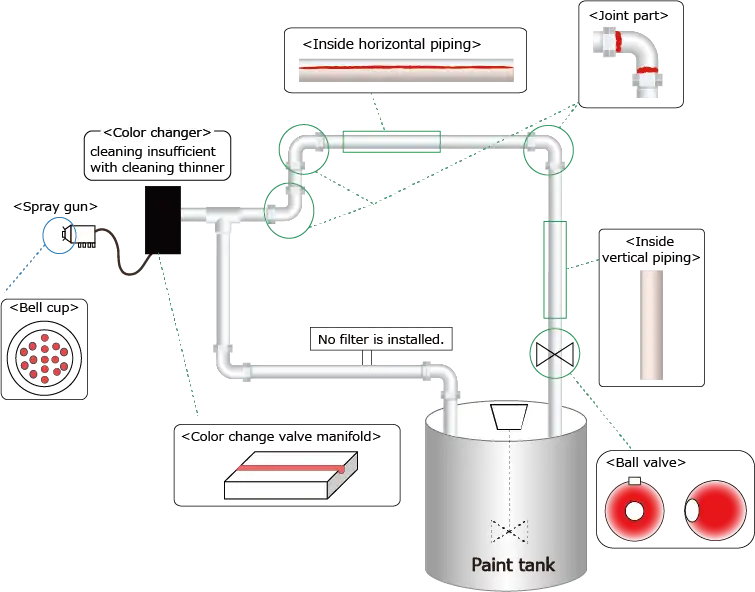
Typical Paint Line Flow and Areas Where Paint Tends to Accumulate

Horizontal PipingAn air space can form in the upper part of the pipe, allowing paint to harden at the liquid-level interface.
Pipe JointsPaint can accumulate in steps and gaps around pipe joints.
Ball ValvesPaint can adhere to the outer surface of the ball.
Color ChangersPaint can adhere to paint passages in components such as color-change valve manifolds.

General characteristics

Application Mask jig ―
Bell cup / Gun ○
Paint piping ○
pH Neutral
Effects on metals Al △
Cu ○
Fe △~×
SUS ○
Ni plating ○
Operating temperature Room temperature to 50℃
Packaging 18 kg/can

Related Articles & Products

Thumbnail for the page explaining cratering defects in painting processes Technical Solutions
Preventing Painting Defects: Examples of Cratering
Cratering occurs when a contaminant with lower surface tension than the liquid paint contacts the coating. The contaminant spreads across the paint surface, causing the coating film to become thinner in that area. This page introduces numerous examples of cratering defects.
Thumbnail for the page explaining particle defects in painting processes Technical Solutions
Preventing Painting Defects: Examples of Particle Contamination
Particle defects can originate from paint as well as small contaminants such as dust, fibers, and insects, and electrostatic attraction can make these problems more severe. Solving these defects requires observation and an understanding of the surrounding environment. Review your process using these examples of particle defects.

Contact Us for Preliminary Cleaning Tests and Samples

Are you facing painting-line cleaning or color-change problems such as dried paint that remains around color changers or liquid-level areas in piping, particle defects and paint loss during color changes, or the burden of wastewater treatment and neutralization associated with strongly alkaline or acidic cleaning solutions?
We can also conduct preliminary dissolution and cleaning tests based on your piping specifications, such as stainless steel, and your paint or ink composition. Please feel free to contact us.

Inquiry and question

Please be as specific as possible in your inquiry.
Depending on the contents of your inquiry, it may take some time for us to reply to you.
For SDS, please contact us from [Requests for SDS] button below.
※Sales through the inquiry form are strictly prohibited.

Requests for SDS

KAKEN TECH, MICROCLEANER, MICROCLEAN&MARKLESS and MARKLESS are trademarks of KAKEN TECH CO., LTD. in PRC.
KAKEN TECH is a trademark of KAKEN TECH CO., LTD. in the U.S..

Contact Us

PAGETOP