Deflux machine, MICROCLEANER®

Continuous distillation of rinse liquid ensures
both high quality and "zero wastewater."
Flux Cleaning Machine "MICROCLEANER®"

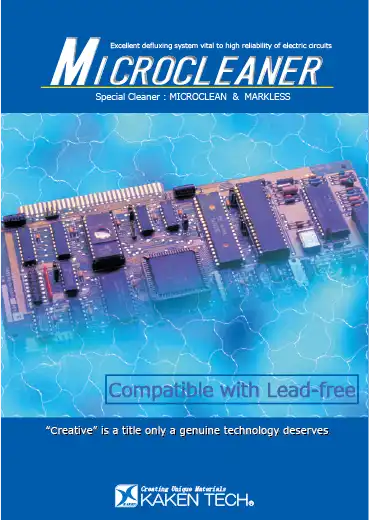
"MICROCLEANER® is a flux cleaning system designed to remove flux residues adhering to high-density printed circuit boards.
Equipped with a distillation and recycling unit as standard, it continuously purifies and reuses the rinse solution, achieving both high-quality cleaning and "zero wastewater, no waste liquid." It is particularly adopted by EMS companies, automotive electronic component manufacturers, power device manufacturers, and high-reliability PCB manufacturers.

What Is Flux Cleaning?

Flux cleaning is the process of removing flux residues left on the circuit board after soldering.
In recent years, with the increasing density of component mounting?such as BGA, CSP, and 0201/01005 components?even minute amounts of residue can cause insulation failures, corrosion, and ion migration. As a result, the importance of flux cleaning has grown, particularly in high-reliability applications.

For more details, please see the related article.

Product Features

01

Optimized Process Development Through Integrated Development of Cleaning Agents and Cleaning Equipment

Kaken Tech is the only manufacturer in Japan that designs and manufactures both flux cleaning agents and cleaning equipment entirely in-house manufactures both flux cleaning agents and cleaning equipment entirely in-house. Based on the chemical composition of the solder flux, the workpiece size of the circuit boards, and production volume (processing capacity), we propose an error-free, optimal cleaning process that integrates both chemical (agents) and mechanical (equipment) aspects.

02

Continuous Purification via a Distillation Regenerator and Zero Wastewater

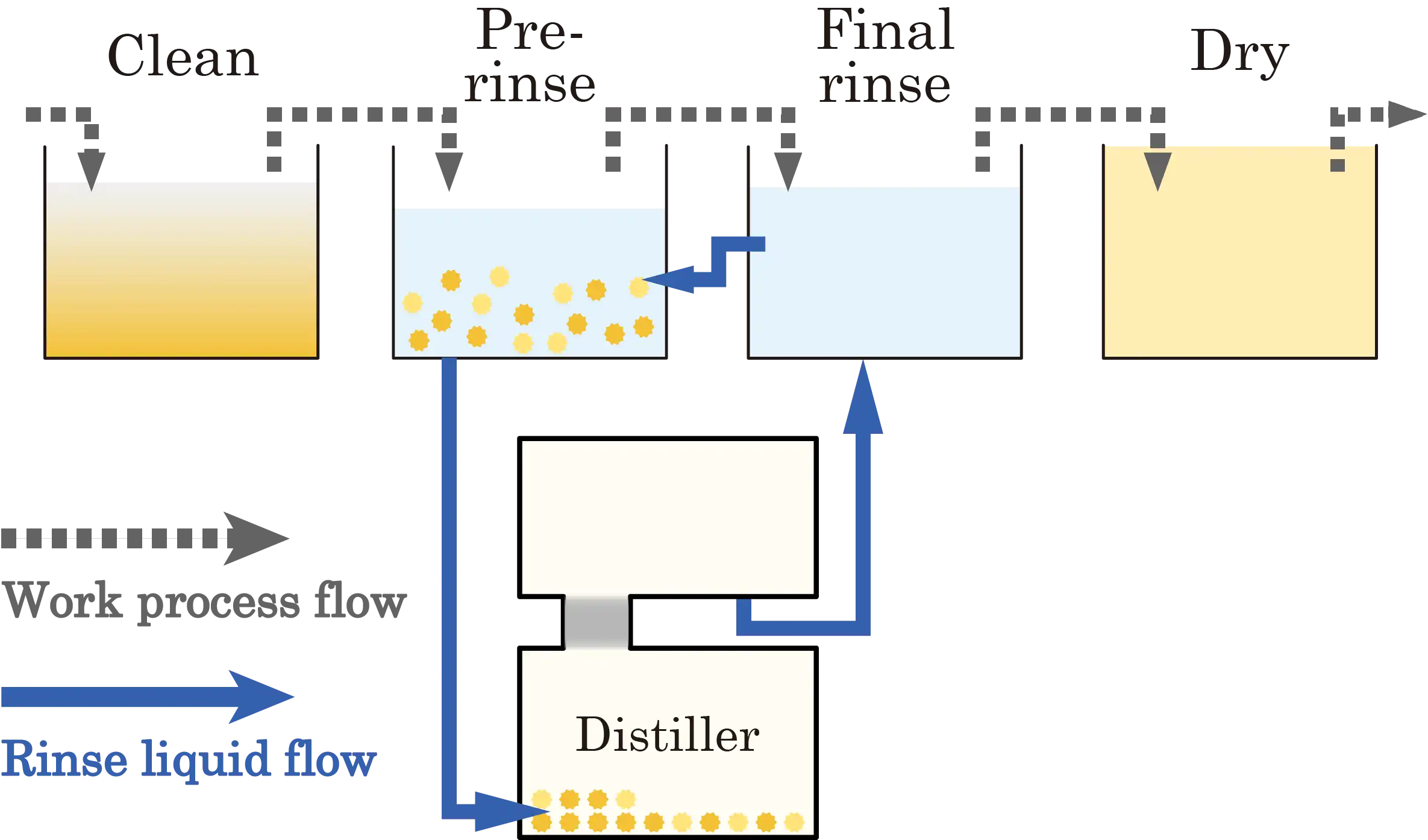
A compact distillation regenerator is standard equipment within the system. It continuously distills and recycles a dedicated rinse agent under reduced pressure, recycled, ensuring the final rinse tank consistently maintains the cleanliness level of fresh solution and thoroughly eliminates any residual drying stains. Furthermore, the absence of a water rinse process results in zero wastewater and no waste liquid, maintaining exceptionally low operating costs.

03

A design philosophy that covers everything from mass-production line automation to prototyping

We are capable of designing, developing, and manufacturing a wide range of systems?from the "4-tank, 120 cm wide" ultra-compact manual transport type for prototyping and research departments to large-scale automatic transport types with processing capacities that meet the demands of EMS companies and mass production processes.

Common Challenges

Are you facing these equipment operation and quality control issues when cleaning flux from mass-produced printed circuit boards?

  • The enormous burden of wastewater treatment and drainage management associated with the introduction of water-based semi-water-based cleaning machines: the enormous burden of wastewater treatment and discharge management
    Because these cleaning systems use large amounts of water, they strain the capacity of on-site wastewater treatment facilities and create challenges regarding maintenance efforts and wastewater disposal costs required to meet strict water quality regulations (such as COD and BOD values)
  • The occurrence of drying stains (marks) and defects caused by microscopic residue
    As continuous production proceeds, the detergent concentration in the rinse tank gradually increases, leading to ionic residue and white drying stains (liquid residue) after the PCBs are dried, which threatens the circuit reliability (insulation) of high-density PCBs
  • Limitations in responding to line layout changes or relocation due to equipment being too large and complex
    Batch-type and large-scale in-line washers, such as those manufactured overseas, have a very large footprint, making flexible relocation and repositioning impossible when modifying or expanding factory production lines, which acts as a hindrance to equipment operation
  • Increased complexity in liquid balance management and the significant manual effort required to maintain cleaning quality
    Staff are overwhelmed by the task of managing the balance of liquid concentration and temperature across each slot in multi-tank systems, as well as the frequent replacement of consumables (such as filters), and the maintenance workload required to ensure stable operation of the cleaning equipment is placing a heavy burden on the production floor

Benefits of Adoption by Industry

Automotive Electronic Components
Enhanced management of flux residue on circuit boards, which require long-term reliability.

EMS Companies
Flexible support for high-mix, low-volume production.

Power Devices
Achieves high insulation performance and low ionic residue levels.

Medical Devices
Improves reliability through high-quality cleaning.

Standard Specifications and Equipment Lineup

The MICROCLEANER® flux cleaning machine consists of four tanks: a cleaning tank, a rinse tank, a final rinse tank, and a drying tank.
In addition, the system comes standard with a compact distillation regenerator, which continuously purifies and recycles the rinse solution. This system achieves both high cleaning quality and zero waste liquid, while also keeping operating costs low.

The specifications below are an example of a standard model. We offer custom design and contract manufacturing to meet specific requirements such as workpiece size, cleaning volume, and factory layout space.

Conventional water-based and semi-water-based cleaning machines require large volumes of rinse water, making wastewater treatment facilities and water quality management significant challenges. In contrast, the Micro Cleaner comes standard with a distillation and regeneration system that continuously regenerates the rinse solution, enabling zero-wastewater operation.
A detailed comparison of cleaning methods is provided on the page below.

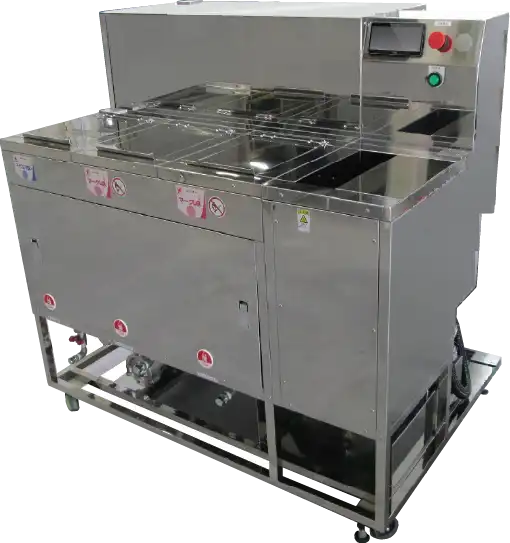
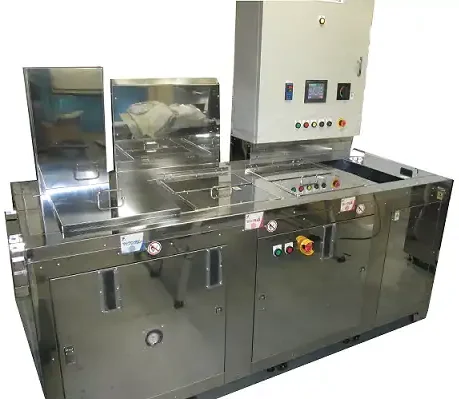
■ For Prototyping and R&D Departments (Model: MC3HD-1.5E)

Manual Conveyor, Small Flux Cleaning Machine - Exterior

Model MC3HD-1.5E
External Dimensions W.1,230 × D.850 × H.1,200 mm
Power Supply 3-phase 200 V
Tank Configuration 1 washing tank, 2 rinse tanks, 1 drying tank
Washing Capacity Equivalent to A5 size: 80 sheets / 8h
Tank Size (Opening) W.100 × D.300 mm
Tank Liquid Capacity Approx. 9 L
Applicable Substrate Size Max. 200 × 165 mm (max.)
Regeneration System Built-in distillation regenerator (extends solvent life)
Required Auxiliary Equipment Local exhaust system ・ Cooling water supply system

■ For Mass Production and EMS Processes (Model: MC3HD-6E)

Manual Conveyor, Large-Scale Flux Cleaning System (Exterior View)

Model MC3HD-6E
External Dimensions W. 2,000 × D. 1,200 × H. 1,810 mm
Power Supply 3-phase 200 V
Tank Configuration 1 cleaning tank ・ 2 rinse tanks ・ 1 drying tank
Washing Capacity A4 size equivalent: 160 sheets / 8h
Tank Size (Opening) W.200 × D.500 mm
Tank Liquid Volume Approx. 50 L
Applicable Substrate Size Max. 370 × 345 mm (max.)
Regeneration System Built-in distillation regenerator (extends solvent life)
Required Auxiliary Equipment Local exhaust system, cooling water supply system

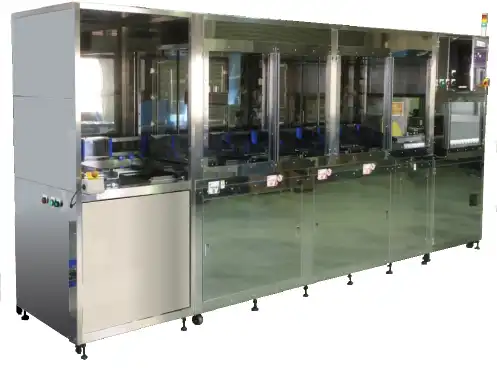
■ For Highly Automated Production Lines (Model: MC4HD-6E-AS)

Large Flux Cleaning Machine with Automatic Conveyor Mechanism ? Exterior View

Model MC4HD-6E-AS
External Dimensions W. 4,000 × D. 1,200 × H. 1,900 mm
Power Input 3-phase 200 V
Tank Configuration 1 wash tank, 3 rinse tanks, 1 drying tank
Washing Capacity A4 size equivalent: 500 sheets / 8 hours
Tank Size (Opening) W.200 × D.500 mm
Tank Liquid Capacity Approx. 50 L
Applicable Substrate Size Max. 370 × 345 mm (max.)
Recovery System Built-in distillation recovery unit (extends solvent life)
Required Auxiliary Equipment Local exhaust system, cooling water supply system

System Introduction Video

Dedicated Cleaning Agents and Rinsing Agents

Thumbnail for the Flux Cleaner page Product Information
MicroClean Markless Flux Cleaner®
At Kaken Tech, we have developed and propose a proprietary cleaning process that combines the glycol-based cleaner MicroClean+ with an aqueous alcohol rinse agent using Markless®. We introduce Kaken Tech"s proprietary cleaners and rinse agents, which address the drawbacks of hydrocarbon-based cleaners and semi-aqueous cleaning systems.
Thumbnail for the product page of MicroClean ECO and Markless ECO, high-performance, low-VOC flux cleaning agents Product Information
High-performance, low-VOC flux cleaners: MicroClean ECO and Markless®ECO
Flux cleaning is essential for ensuring the reliability of high-density printed circuit boards. Amid tightening regulations on chemical substances?such as the discontinuation of alternative CFCs due to environmental regulations and VOC restrictions under China"s GB standards?Kaken Tech has developed the "MicroClean ECO & MarklessR ECO Series" of high-performance, low-VOC cleaning agents that achieve both ultra-precise cleaning and environmental compliance.

Frequently Asked Questions

What kind of cleaning agent is used with the Micro Cleaner flux cleaning machine?
The Micro Cleaner flux cleaner uses the dedicated cleaning agent Micro Clean MarklessR.
For details on the flux cleaning agent, please click the button below to proceed to the product page.

Click here for the flux cleaning agent

Can I conduct cleaning tests using the actual machine?
We can conduct cleaning experiments (tests) using the Micro Cleaner ® flux cleaner at our Technical Development Laboratory (Gamo District, Shiga Prefecture).
If you are interested, please select "Evaluation/Demo" from the inquiry form at the bottom of this page and contact us.
A sales representative will contact you with further details.

Related Articles & Products

Thumbnail for the technical documentation page on flux cleaning Magazine Articles
Technical Documentation ? Flux Cleaning ?
Excerpt from Micro-Assembly and Bonding Technology (2012).
The evolution of flux cleaning agents, the purpose and true significance of flux cleaning, and current technologies and future challenges?with a focus on glycol ether-based cleaning agents, which are currently the most widely used in assembly operations.
Thumbnail for the technical documentation page on cleaning machines in the assembly process Magazine Articles
Cleaning Machines in the Assembly Process
Excerpt from Micro-Mounting and Bonding Technology (2012). This article explains the fundamentals of designing flux cleaning processes, as well as representative cleaning systems with a proven track record in the mounting process and examples of cleanliness control.
 
Thumbnail for the Flux Explanation Page PCB Assembly Column
The Key Player in Soldering! What Is Flux?
Flux is a soldering aid composed of ingredients such as rosin (pine resin), activators, and solvents. This page explains the role and types of flux.
 
Thumbnail for the page explaining flux cleaning Help Page for Troubleshooting
What Is Flux Cleaning?
The process of removing flux residue that accumulates during soldering when mounting electronic components, "flux cleaning." This page explains why flux needs to be cleaned, what cleaning methods are available, and what is required for efficient cleaning.
 

Consultations on Cleaning Tests and System Implementation

To address challenges associated with flux cleaning equipment?such as reducing drainage and wastewater treatment costs, eliminating drying stains, and saving space?we can conduct demonstration cleaning and evaluation using the MICROCLEANER at our Technology Development Research Laboratory (Shiga Prefecture). We will propose the optimal cleaning process tailored to your circuit boards, so please feel free to contact us.

Inquiry and question

Requests for SDS

Please be as specific as possible in your inquiry.
Depending on the contents of your inquiry, it may take some time for us to reply to you.
For SDS, please contact us from [Requests for SDS] in the upper right corner.
※Sales through the inquiry form are strictly prohibited.

KAKEN TECH, MICROCLEANER, MICROCLEAN&MARKLESS and MARKLESS are trademarks of KAKEN TECH CO., LTD. in PRC.
KAKEN TECH is a trademark of KAKEN TECH CO., LTD. in the U.S..

Contact Us

PAGETOP