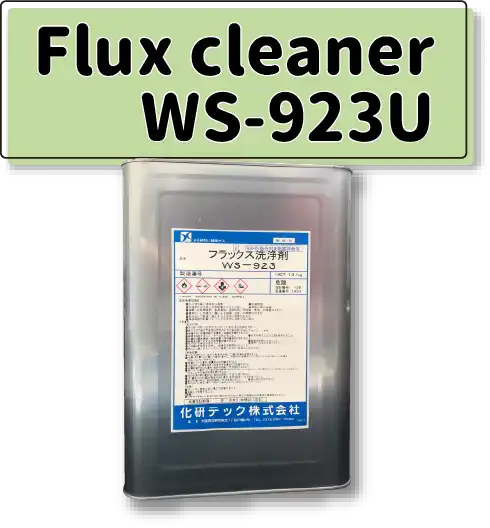
PCB defluxing cleaner WS-923U

Published on :

Dissolves and removes stubborn, baked-on flux
at a rate several times faster than IPA.
Flux cleaning agent / flux remover “WS-923”

Ideal for flux cleaning during PCB repair processes and reflow oven maintenance. Unlike IPA (isopropyl alcohol), which is commonly used in the electronics industry, it combines overwhelming solubility against strongly baked-on flux with rapid drying properties.

Product Features

01

Flux-dissolving power that far surpasses IPA and excellent quick-drying properties

Quickly softens and completely dissolves dried flux after repairs and stubborn rosin deposits accumulated inside reflow ovens. Not only does it significantly improve flux dissolution and removal speed compared to IPA, but its extremely high volatility (fast-drying properties) also eliminates the need for post-cleaning wiping and drying steps, dramatically improving work efficiency.

02

Ensuring Regulatory Compliance and Safety Through Exemption from the Organic Solvent Poisoning Prevention Regulations

Exempt from the “Organic Solvent Poisoning Prevention Regulations” under the Industrial Safety and Health Act and the Poisonous and Deleterious Substances Control Act. This eliminates the strong smell of alcohol on-site, the obligation to conduct workplace environmental measurements, and the cost burden associated with maintaining local exhaust ventilation systems, making it easy to establish a safe working environment that complies with legal regulations.

03

Excellent material compatibility that prevents damage to precision circuit boards and mounted components

Despite its high dissolving power, this precision cleaning agent is meticulously formulated to minimize chemical damage to the various electronic components mounted on printed circuit boards (PCBs), as well as to surrounding resins and metal substrates. It reduces the risk of component swelling, deformation, and degradation, thereby maintaining the high quality and reliability of electronic products.

Common challanges

Are you facing these kinds of problems when cleaning manually repaired PCBs with IPA or maintaining reflow ovens?

  • Residual flux and whitening caused by IPA’s insufficient dissolving power
    Flux baked onto the board after repair and stubborn deposits on the fluxer filter cannot be fully dissolved by IPA, requiring time and labor to clean with cotton swabs or brushes; additionally, the PCB surface turns white (white residue forms) after drying, compromising quality
  • The significant manual labor required to clean resin deposits accumulated on parts and trays inside the reflow oven
    Maintenance cleaning of flux and resin firmly caked inside the oven involves using large amounts of IPA and spending considerable time and manpower to scrub them off, and this non-productive work is negatively impacting the operational efficiency of the production line
  • The burden of workplace environmental monitoring and regulatory compliance associated with the use of substances subject to the Organic Solvents Regulations (such as IPA)
    Countermeasures against the pervasive odor of alcohol (organic solvents) on the shop floor, workplace environmental monitoring based on the Organic Solvents Regulations under the Industrial Safety and Health Act, regular health checkups, and the man-hours required for document management and administrative compliance to ensure legal compliance
  • Strain on maintenance and management costs for storage facilities due to exceeding the designated quantity of hazardous materials at the factory
    The amount of IPA (Class 4 hazardous substance: alcohols) used and stored within the factory for manual cleaning of printed circuit boards and reflow maintenance has increased, causing concerns regarding exceeding the designated quantity limits under the Fire Service Act and the maintenance costs of explosion-proof equipment

Instructions for Use

・Many customers using the 18L can package transfer the solution from the can into smaller containers, such as cleaning bottles or hand-held spray bottles, for use.

・When cleaning flux from circuit boards or around components, apply the cleaning agent to the soiled area and rub it with a cotton swab or similar tool.
To clean components by immersion inside a reflow oven, fill a tray, container, or similar vessel with WS-923 and immerse the components.
To minimize evaporation loss, we recommend covering the container with a lid during immersion.

Frequently Asked Questions

Is a flux cleaning agent different from a “flux remover”?
Solder flux removers are sold by many manufacturers and are referred to by various names, such as “flux cleaning agent,” “flux remover,” and “flux cleaner.” Although the names differ, they all serve the same function: removing flux.
Is rinsing necessary after cleaning with WS-923 flux cleaning agent?
No, it is not necessary.
Since WS-923 is composed entirely of volatile components, a rinsing step after cleaning is not required. Because it dries quickly, it will air dry naturally after cleaning.
Is the handling of Flux Cleaning Agent WS-923 the same as that of IPA?
The physical properties of Flux Cleaning Agent WS-923 and IPA are shown in the table below.
Cleaning Performance Flash Point UN classification
Flux Cleaning Agent
WS-923
High😀 -12℃ Class3 / UN1993
IPA Low🙁 11℃ Class3 / UN1219
In addition, the main precautions when handling Flux Cleaning Agent WS-923 are as follows:
・Due to its extremely low flash point, it is strictly prohibited to use this product in electrical equipment (such as ultrasonic cleaners or bubble cleaners).
・Do not use near open flames, and ensure the work area is well-ventilated.
・Keep the container tightly sealed, avoid direct sunlight, and store in a cool, dark place.
Wear safety goggles, protective gloves, etc., during use, and avoid direct contact.
・Dispose of waste liquid (treated as industrial waste/used oil) through a licensed industrial waste disposal contractor.
Detailed precautions regarding this product are listed in the Safety Data Sheet (SDS); be sure to review it before use.

Product Introduction Video

High Flux Dissolving Power! ~Compared to IPA~

We compared the dissolution of flux by soaking test pieces—made by solidifying flux adhering to a fluxer filter—in IPA and the flux cleaning agent WS-923, observing how long it took for the flux to dissolve completely. The flux soaked in the flux cleaning agent WS-923 dissolved completely in about 7 minutes, whereas the IPA had barely dissolved any flux even after 7 minutes.
The WS-923 flux cleaning agent has a higher flux-dissolving power than IPA.

Flux Cleaning Demo! Flux Filter Edition

We tested Flux Cleaning Agent WS-923—which is ideal for cleaning flux after solder repairs due to its high cleaning power and quick-drying properties—on a filter from a spray fluxer that had flux caked onto it.
We cut the filter to a suitable size and soaked it in both IPA and WS-923 to compare their dissolving power. After just 5 minutes of soaking, it demonstrated amazing flux-dissolving power.

General characteristics

Main component Hydrocarbons and alcohols-based
Specific gravity 0.73
Boiling point 79~100℃
Flash point -12℃
UN Class 3
UN No 1993
Packing Group
Package 13kg / UN can

Related articles and products

Trouble solution
"Cleaning" in Electronics industory
Cleaning related to the mounting process is explained using the example of the double-sided mounting process, in which inserted components are mounted (flow process) after surface mounting (reflow process) .
PCB Mounting Columns
What is flux, the leading actor of soldering ?
In addition to what flux is, its role, composition, and types, we will also explain the problems caused by flux residue left after soldering and how to prevent them.
Trouble solution
Tips on flux cleaning
Flux cleaning is a process to remove flux residue that is generated at the same time as soldering when mounting electronic components. This page explains why flux is cleaned, what cleaning methods are available, and what is required for efficient cleaning.

Request a Preliminary Dissolution Test or Evaluation Sample

Are you facing cleaning challenges in electronics assembly processes, such as:
“Flux residues or white residue (whitening) remaining after IPA cleaning,” “Reducing the time and labor required for cleaning reflow oven tar and residue buildup,” or “Switching to a safer cleaning solution”?
We offer preliminary dissolution testing and evaluation samples tailored to the solder and flux compositions used on your PCBs, as well as the level of contamination inside your reflow ovens. Please feel free to contact us to discuss your application requirements.

Inquiry and question

Requests for SDS

Please be as specific as possible in your inquiry.
Depending on the contents of your inquiry, it may take some time for us to reply to you.
For SDS, please contact us from [Requests for SDS] in the upper right corner.
※Sales through the inquiry form are strictly prohibited.

KAKEN TECH, MICROCLEANER, MICROCLEAN&MARKLESS and MARKLESS are trademarks of KAKEN TECH CO., LTD. in PRC.
KAKEN TECH is a trademark of KAKEN TECH CO., LTD. in the U.S..

Contact Us

PAGETOP